Managing FX Risk & Currency Volatility in Produce Trading
You priced the deal right. The logistics worked and the product arrived fresh. And then the exchange rate moved 3% and your profit VANISHED. For the fresh produce industry, this is the hidden cost nobody usually talks about: currency risk in produce.
The Way Currency Moves May Eat Your Margins
In the fresh produce industry, margins are tight and timing is everything. But there’s a cost most businesses don’t see coming: foreign exchange risk. For importers and exporters trading between the U.S., Mexico and Canada, currency volatility isn’t a financial detail: it’s a core business risk and it can turn a profitable deal into a loss overnight.
If you’re buying or selling produce across borders, you’re certainly exposed to currency fluctuations, whether you realize it or not. The timing gap between when you agree on a price and when you actually pay is where the damage happens.
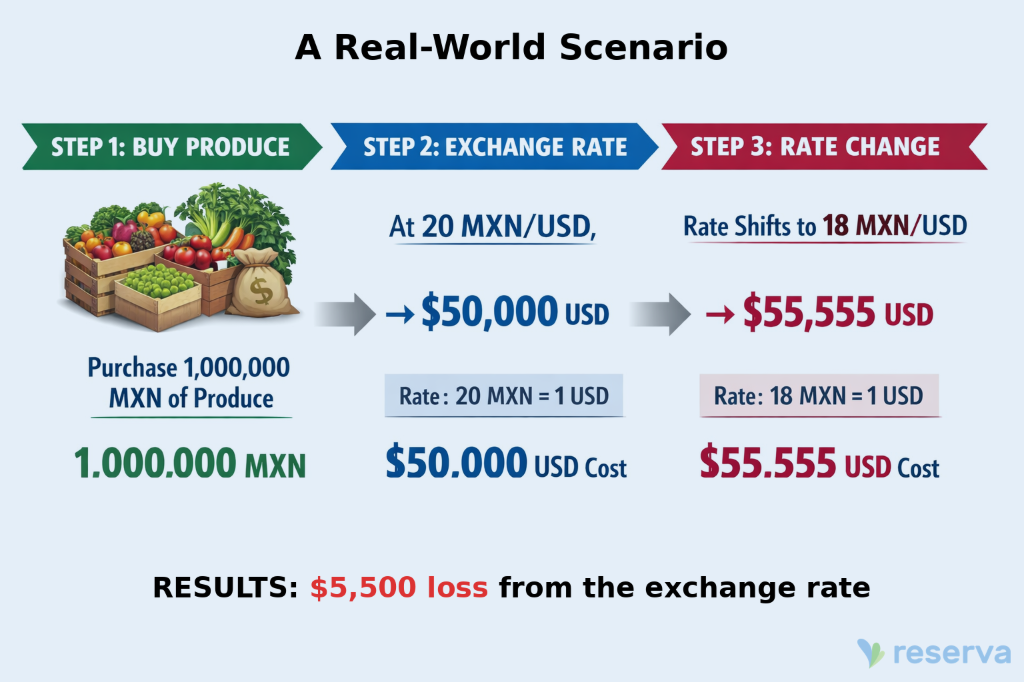
Now multiply that across weekly shipments, multiple suppliers and seasonal volume spikes. FX volatility can easily become one of the largest hidden costs in your business.
The USD/MXN rate moved 8% in 2024. On a $500K monthly import spend, that’s $40,000 in unplanned cost.
Match Currency Inflows and Outflows
Buy and sell in the same currency when possible. If you purchase in MXN, try to price sales in MXN too. It creates a natural hedge.
Shrink the Timing Gap
The longer the gap between agreeing a price and paying, the higher the risk. Shorten payment cycles. Use faster payment methods. Align invoicing and settlement.
Track Rates in Real Time
Static rates and manual updates are risky. Real-time visibility lets you lock in favorable rates, delay payments strategically, and adjust pricing when needed.
Centralize FX and Payments
Managing FX across multiple banks and spreadsheets creates blind spots. A centralized system tracks exposure, reduces fees, and speeds up decisions.
4 Ways to Manage FX Exposure (Without a Treasury Team)
Most produce companies don’t have a dedicated Treasury Department but that doesn’t mean you can’t manage currency risk.
The USD/MXN Reality in Produce
Cross-border trade between the U.S. and Mexico is one of the most active corridors in the produce industry. Mexican suppliers often price in MXN while U.S. buyers operate in USD. And the exchange rate can move significantly within days.
A strengthening peso increases costs for U.S. importers. A weakening peso helps, but only if timing is on your side.
Without a strategy, you’re effectively speculating on currency movements often without realizing it.
How Reserva Helps You Manage FX Risk
Instead of treating FX as a separate banking function, Reserva embeds it directly into your daily operations.
Turn Currency Volatility Into a Competitive Advantage
Currency volatility is part of doing business in global produce. But absorbing its impact isn’t.
The companies that win aren’t the ones trying to predict the market: they’re the ones built to respond to it. They shorten the gap between pricing and payment by using tools like Reserva Forex, effectively gaining visibility into their exposure and moving fast enough to lock in certainty when it matters. Because in produce, margins aren´t just determined by what you buy or sell: it’s defined by how well you manage what happens in between.
The exchange rate will move whether you like it or no, the question is whether it moves against you and your business operation or whether you’re in control when it does.
Ready to Get FX Under Control?
Book a 15-minute demo to see how Reserva handles FX for Produce Businesses, with real numbers for your trade corridors