Why Traditional Banking Is Failing Fresh Produce Businesses
You can get avocados from Michoacán to Miami in 36 hours. But paying the grower? That takes a week and costs $45 in wire fees. Something’s broken and the fact is: your Bank is too slow for the Industry you move on.
When Payments Move Slower Than Products
The fresh produce industry has spent the last decade modernizing logistics, cold chain and inventory management. But one critical piece still runs on infrastructure built in the 1970s: international payments.
Fresh produce crosses borders in days but international wire transfers take 3 to 7 business days to settle. That gap creates a dangerous disconnect between the movement of goods and the movement of money. Suppliers often wait for confirmed funds before releasing shipments or prioritizing orders. That means payment delays don’t just live in accounting: they stall inventory, push back delivery windows and add costs like storage or demurrage. In an industry where freshness declines by the hour, every day a payment is stuck in transit is a day of lost value.
Nearly 40% of B2B payments experience delays, with more than half of suppliers worldwide report receiving payments after the agreed terms: what starts as a financial delay quickly becomes an operational problem.
The average cross-border payment costs over 6% of the transaction value and 70% of businesses admit they’re paying unnecessarily high fees.
The Real Cost of “Just Sending a Wire”
Sending a wire feels simple. The infrastructure behind it is anything but. Most cross-border payments move through a chain of intermediary banks before reaching their destination. Each step adds time, cost, and uncertainty. By the time funds arrive, they’re often reduced by intermediary fees. Businesses spend hours reconciling discrepancies instead of running operations. And the visible fees, ranging from $25 to $50 per wire, are just the tip of the iceberg.
For a produce company moving $100,000 internationally each week, that’s potentially thousands of dollars lost every month. In a low-margin industry, that’s a silent drain on profitability.

Growers and Exporters
They rely on consistent, reliable buyers. When payments are slow or unpredictable, that trust erodes and the consequences become something real.

Suppliers
They naturally prioritize partners who pay quickly and without friction. Over time, slow payers get worse pricing, less access to high-demand inventory and lower priority during peak season.
In competitive markets, being a reliable payer isn’t just good ethics — it’s a strategic advantage.
But traditional banking makes that reliability almost impossible to achieve.
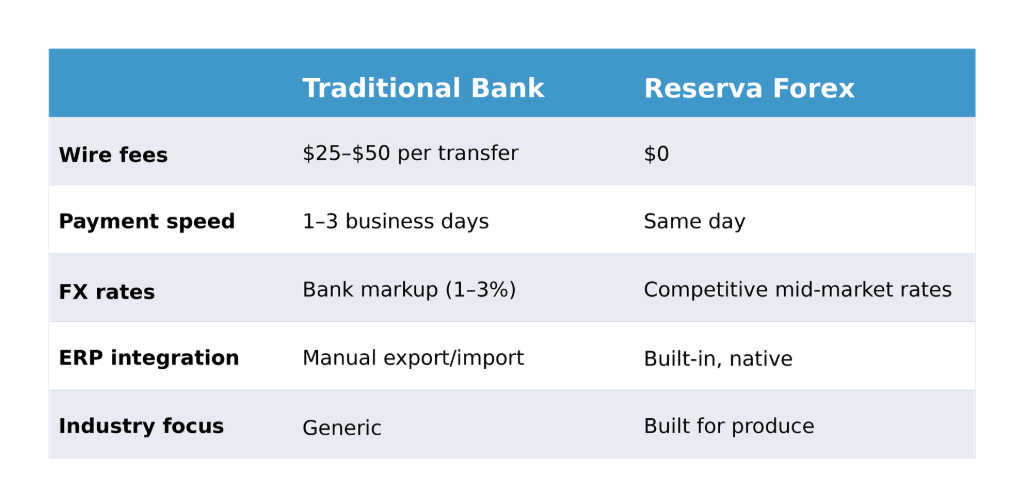
Traditional Banks vs. Reserva Forex
See how Reserva Forex positions itself as a modern solution for cross-border payments for the Produce Industry.
Built to save you money and speed up transactions.
Built for the Way Produce Actually Moves
Payments reliability in the Produce Industry is a problem, that´s a fact, but this is exactly the problem Reserva Forex was built to solve.
Instead of relying on outdated wire systems, Reserva Forex enables same-day international payments to key trade corridors, including Mexico. By paying suppliers in local currency (MXN, CAD, USD), businesses eliminate wire fees entirely. And competitive, transparent exchange rates mean no hidden FX markups eating into margins.
Faster payments mean suppliers get paid on time, in full, without friction. That reliability strengthens relationships and improves access to inventory. And because Reserva Forex integrates directly with the Reserva ERP and Treasury platform, payments connect seamlessly to operations, accounting and cash flow management. It´s an all-in-one system perfectly built for the Produce Business.
The Real Bottleneck in Produce Isn’t Logistics: It’s Payments
The produce industry has already modernized how it grows, moves and sells products so, naturally, payments are the next frontier.
Traditional bank wires, used nowadays for most small-medium size Produce Business, introduce delays, hidden costs and uncertainty into a system that depends on speed and precision. That´s the main reason on why modernizing international payments isn’t just about saving money: it’s about removing friction from the supply chain, strengthening supplier relationships and staying competitive in a global market. Because in produce, timing isn’t just important: it’s everything.