Skip to Content
GROWER INVENTORY MANAGEMENT

Complete Visibility Into Grower-Owned Inventory

Manage products belonging to multiple growers in the same operation while keeping every owner's quantities, lots, locations, costs and inventory value separately identifiable.

Produce companies often store product from several growers in the same warehouse. The product may share a commodity, variety, grade, size or package, but the inventory still belongs to different owners.


Grower Inventory Management lets produce companies manage inventory by ownership, so product belonging to multiple growers can be stored and handled within the same operation while each grower’s quantities, lots, locations, costs and inventory value remain separately identifiable.


Reserva brings those details together in the inventory record where operators can see the overall stock position and then move into the owner, warehouse, location and lot records that explain the balance, without reconstructing it from spreadsheets or disconnected records.

What Grower Inventory Management Means for Produce Companies

Traditional inventory answers "How much inventory do we have?" but fresh produce companies handling grower-owned product also need to answer "Whose inventory is it?"

Similar products can occupy the same warehouse without becoming one indistinguishable balance, however, Reserva preserves the context required to manage each inventory position responsibly, so Teams can review the broad stock position and then examine the owners, products, warehouses, locations and lots behind it.

Quantity

What do we have?

The overall product and warehouse position.

ACCOUNTABILITY

Who owns it?

The grower, lot, location, quantity, cost and value behind the balance.
See the Complete Inventory Position

Reserva gives operators a summarized view of inventory by product and warehouse, bringing together the quantities and context needed to evaluate current stock and upcoming demand.

01

Understand On-Hand, Available and Reserved Quantities

See what is physically recorded, what remains open for use and what is already committed before making another promise.

02

Review Demand Alongside Current Stock

Compare current availability with open orders, in-transit quantities and forecasts to place demand in context.

03

Compare Product Across Warehouses

Understand where quantities are held and identify product that exists but is not stored where expected.

04

See Pallets, Cost and Inventory Value

Keep the physical balance alongside pallets, cost and value for a fuller understanding of what is being held.

Understand the Owners and Lots Behind Every Balance

Products can share a commodity and warehouse without being the same inventory.

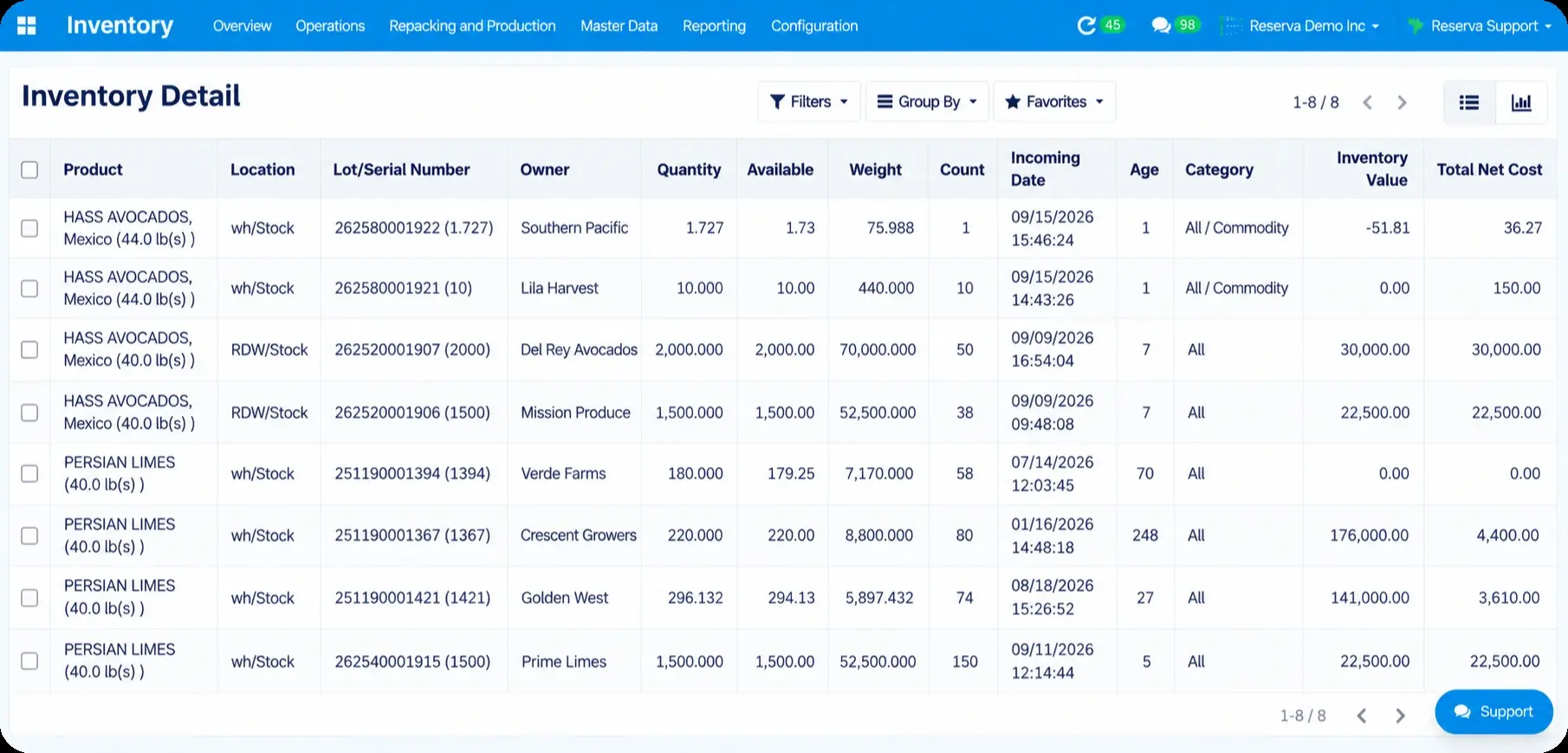
Reserva keeps grower-owned positions distinct from other growers and from company-owned stock, allowing teams to review inventory by owner and examine the product, warehouse or location, lot, quantity, weight, incoming date, age, category, cost and value associated with each record.

Keep Inventory Separated by Owner

Start with an owner's overall balance, then review the specific lots that create it.

Identify Exact Lots

Connect each quantity with its exact lot number.

Confirm Recorded Locations

See the recorded warehouse location connected with each quantity.

Review Quantity and Weight Together

See units and weight together for each lot.

Monitor Incoming Date and Inventory Age

Review incoming date and inventory age when a lot requires attention.

Reserva inventory detail showing grower owners, lots, quantity, location, cost and inventory value
From information to action

Use Inventory Information to Make Better Daily Decisions

Clear ownership and inventory context supports warehouse, sales, fulfillment, operations, accounting and grower-relations decisions.

Confirm Availability Before Committing Product

Compare on-hand stock with availability, reservations, open orders, in-transit product and forecasts before committing a customer quantity.

Maintain Accountability for Grower-Owned Product

Preserve the distinction between inventory physically controlled by the company and product owned by each grower.

Investigate Differences With More Context

When an inventory balance does not match expectations, Reserva brings together key information like ownership, lot, warehouse, location, reservation, weight, entry-date, cost and value context. This helps operators identify where a discrepancy originates before making corrections or requesting additional review.

Build a Dependable Foundation for Downstream Work

Packing, sales, fulfillment, reporting and grower accounting begin with the same owner, product, lot, location, availability, cost and value context. Because of the inventory position is clear from the very beginning, downstream teams begin with a more dependable record.

Who Benefits From Grower Inventory Management?

Inventory & Warehouse Teams

See on-hand and available quantities, storage location, inventory age, lot and owner.

Sales & Fulfillment Teams

Review availability, reservations, demand, in-transit quantities and forecasts before committing.

Operations Managers

Compare warehouses, identify older balances and open the records behind a summarized position.

Accounting & Grower-Relations Teams

Review owner, lot, quantity, cost and value as context for reporting and accounting, without turning inventory into settlement.

Maintain Visibility and Accountability Across Grower Inventory

Grower Inventory Management gives produce companies a clear view of the product currently under their control while preserving the ownership context behind it.

Reserva connects each inventory position with the details that explain it. This way produce Teams can see the larger inventory picture when planning their work and move into owner and lot-level detail when a specific quantity needs attention.

That visibility supports better availability decisions, stronger inventory accountability and a dependable foundation for the workflows that follow.

See Grower Inventory Management in Action

See how Reserva helps produce companies maintain visibility and accountability over grower-owned inventory.

Schedule a Demo