Produce Order Exception Management
Control every change from quote to invoice. Keep orders moving when quantities, products, availability, timing or fulfillment plans change.
The biggest challenge in produce isn't entering orders: it's controlling what happens after they're entered.
Every change to inventory, availability, fulfillment, transportation or customer requirements can trigger a chain reaction across purchasing, warehouse, logistics and accounting workflows. Without a connected system, produce teams can definitely spend their day reacting instead of executing.
Reserva’s Order Management System keeps the complete order context connected as teams respond to shortages, substitutions, holds, partial fulfillment, cancellations and other exceptions. Sales, purchasing, inventory, warehouse, logistics, and accounting can see what changed, why it changed, who is responsible and what must happen next.
What Is Produce Order Exception Management?
It is the process of identifying, assigning, resolving and documenting anything that prevents an order from moving through its expected lifecycle.
Keep the Exception Connected to the Original Order
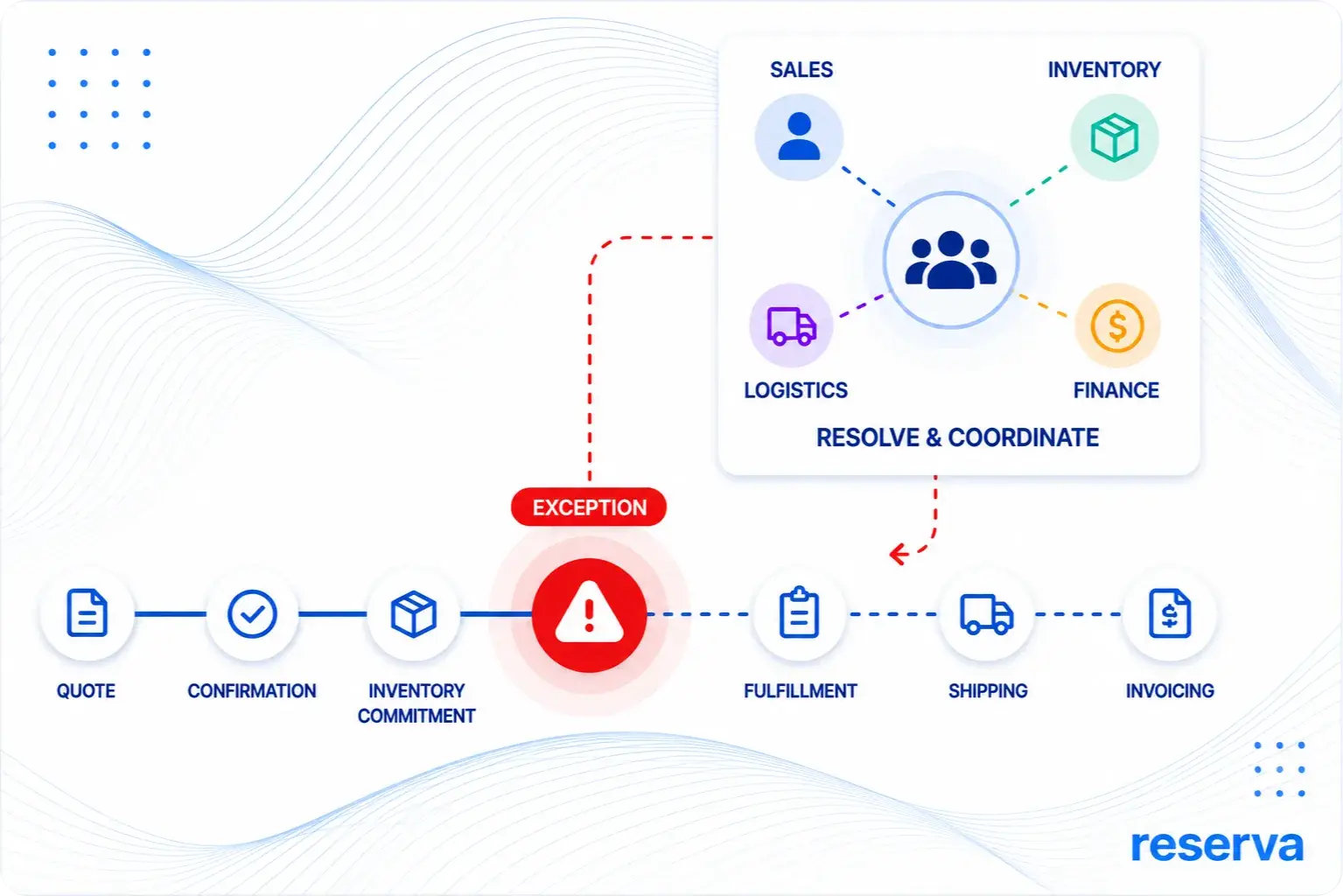
In a standard workflow, an order moves from quote to confirmation, inventory commitment, fulfillment, shipping documentation and invoicing. An exception interrupts that path.
It may affect one order line or the entire produce transaction. The exception may begin in sales, purchasing, inventory, quality, warehouse, logistics or even the finance area. It may be resolved immediately or it may require coordination across several teams. A lot of scenarios can be possible when dealing with a sudden exception in your daily sales workflow.
Reserva OMS gives teams a shared operational layer for managing those situations without rebuilding the order in spreadsheets, email threads or disconnected systems.
The Most Common Produce Order Exceptions
Reserva OMS helps teams respond to the changes that regularly affect fresh produce orders while preserving the operational and commercial context.
Product Shortages and Short Receipts
See which orders are affected when received or available inventory no longer covers every commitment. Prioritize customers, source alternatives, substitute, partially fulfill, or backorder with full context.
Substitutions and Pack Changes
Manage changes in variety, grade, size, label, pack, or unit of measure inside the original order so customer approval, fulfillment instructions, quantities, and pricing remain aligned.
Partial Fulfillment and Backorders
Separate what can ship now from what remains open. Keep shipped quantity, remaining commitment, delivery expectations, documents, and invoiceable amounts connected.
Inventory Reallocation
Move committed inventory between orders when priorities, delivery timing, product condition, customer requirements, or available supply change and keep the impact visible.
Order Holds and Release Conditions
Stop an order for credit, margin, documentation, availability, quality, or operational reasons. Make the reason, owner, and release condition visible before work continues.
Delivery and Fulfillment Changes
Keep updated dates, instructions, carrier expectations, warehouse capacity, and product readiness tied to the same order so teams do not work from conflicting plans.
Cancellations and Line Changes
Coordinate inventory release, purchasing review, warehouse work, document updates, and financial exposure when a customer changes or cancels an order.
One Exception Can Affect Every Team
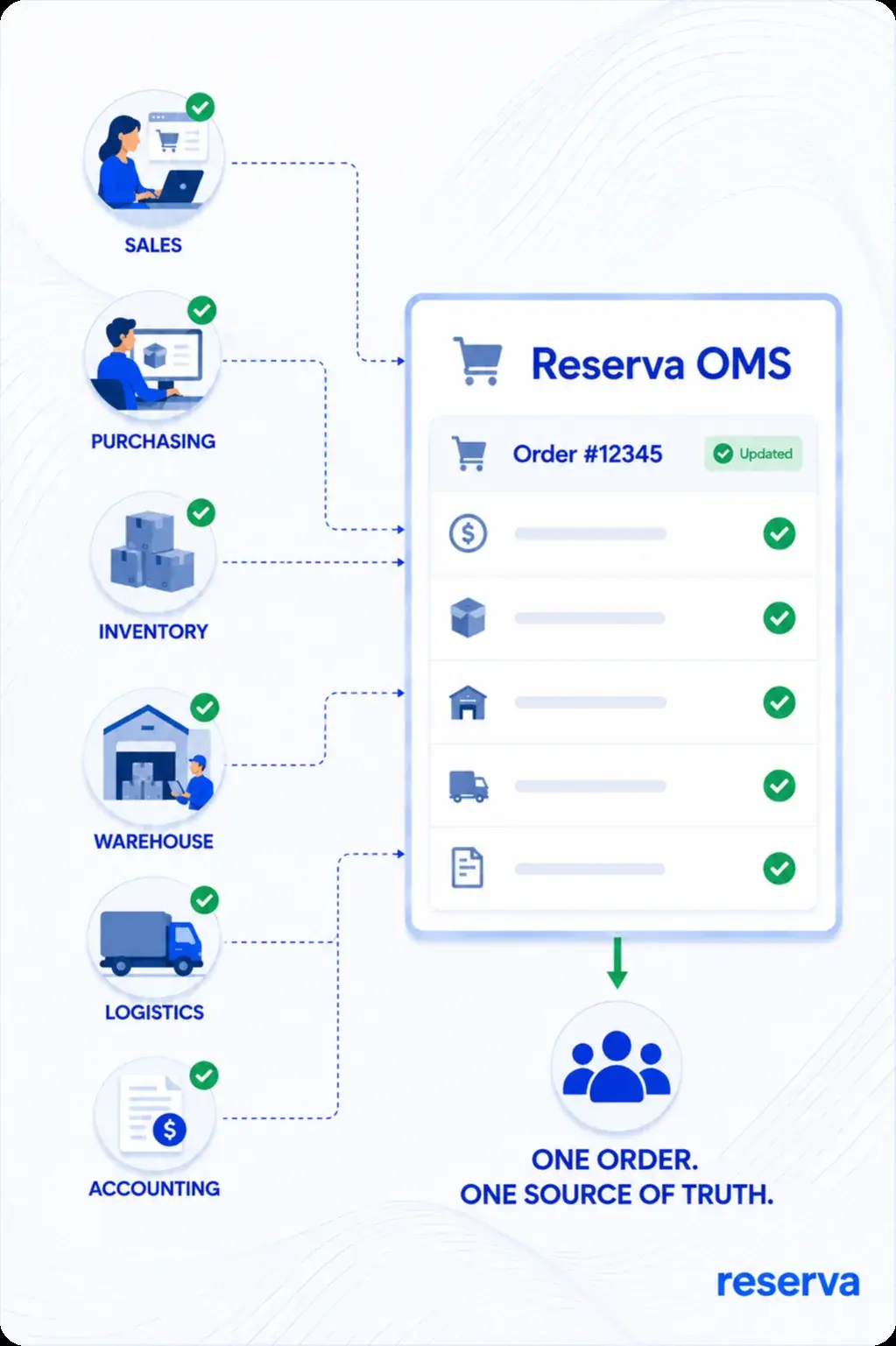
A single change to an order rarely stays isolated. A shortage, substitution, or delayed shipment can quickly affect purchasing, inventory, warehouse operations, logistics, and accounting. Without a connected system, each department reacts independently, creating delays, discrepancies and unnecessary manual work.
Reserva OMS keeps every team aligned by ensuring each function works from the same, up-to-date transaction:
- Sales sees what can actually be promised to the customer.
- Purchasing knows where supply gaps exist and how to respond.
- Inventory reflects what is truly available, allocated, or reassigned.
- Warehouse fulfills the latest version of the order, not an outdated one.
- Logistics ships the right product, quantity and destination.
- Accounting invoices what was actually delivered, not what was originally ordered.
Every change is reflected across the entire order lifecycle, so every team stays aligned without manual reconciliation.
Detect the Exception Before It Becomes a Shipment Problem
The earlier an exception becomes visible, the more options the team has. A shortage identified before picking may be resolved through a substitution or inventory reallocation. The same shortage discovered while loading the truck may cause a delay, an incorrect BOL, a customer complaint and an invoice correction.
Reserva OMS helps teams monitor the conditions that determine whether an order can continue.
Commercial and Supply Signals
- Available versus committed quantity
- Expected versus received supply
- Product, lot, pack and customer requirements
- Credit, margin and approval status
Fulfillment and Document Signals
- Ordered versus picked or shipped quantity
- Fulfillment and delivery timing
- Required shipment information
- BOL, passing and invoice readiness
From Detection to Resolution in One Connected Workflow
Order exception management´s objective is not simply to display an error that was found: it is to give the team enough context to resolve it fast.
Identify
Make the exception visible in the order context instead of allowing it to remain hidden in a separate spreadsheet, message, or verbal update.
Understand the Impact
See which order lines, inventory commitments, purchases, fulfillment steps, documents, and financial values are affected.
Assign the Next Action
Route the issue to the person or team responsible for resolving the commercial, supply, warehouse, logistics, or financial impact.
Resolve and Preserve the History
Update the product, quantity, commitment, timing, hold, or cancellation while retaining the context behind the final decision.
Keep the Original Order and the Fulfilled Reality Aligned
One of the biggest risks in produce operations is losing alignment between commercial commitments and operational execution.
As orders evolve, every related process (from inventory and fulfillment to shipping documents and invoicing) must stay synchronized, otherwise, small changes become costly errors that require manual intervention to resolve.
Reserva OMS eliminates that disconnect by maintaining a single, continuously synchronized transaction. From the moment an order is entered until it is delivered and invoiced, every team works from the same operational reality, not outdated information.
Protect Customer Relationships, Operations, and Margins
When order exceptions stay visible inside the OMS, teams can evaluate their customer, inventory, operational and financial impact before deciding how to respond.
Communicate Earlier and Protect Important Commitments
- Alert customers before fulfillment is affected
- Prioritize high-value or time-sensitive orders
Resolve Changes Without Creating Additional Work
- Prevent duplicate or conflicting fulfillment activity
- Recover released inventory faster
- Keep unresolved orders accountable
Understand the Cost Before Choosing a Resolution
- Reduce avoidable credits and invoice corrections
- Measure the financial impact of operational changes
A Shared Exception Queue for Daily Order Control
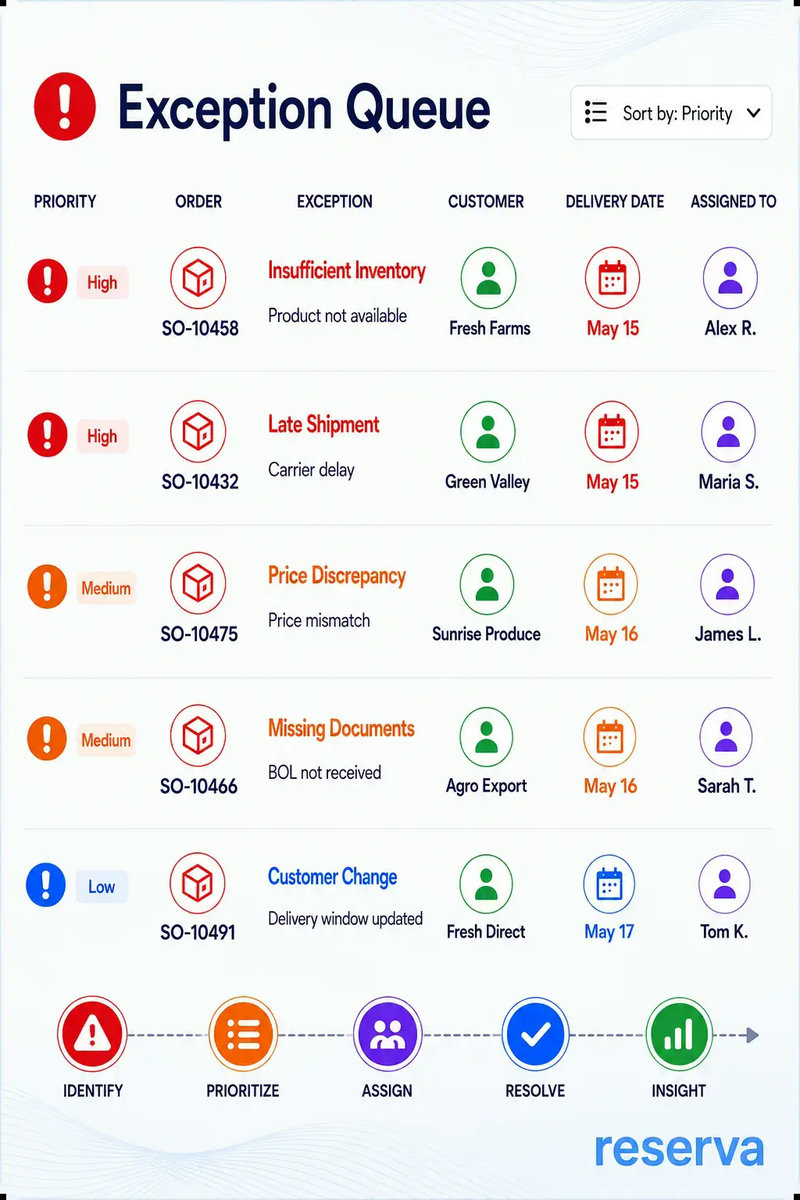
Managing exceptions one order at a time doesn't scale. Produce operations need a single place to identify what requires attention, prioritize what matters most, and coordinate action across teams.
Reserva OMS provides a shared exception queue that highlights the orders requiring immediate action and allows teams to organize work by delivery date, customer, warehouse, priority, responsible user, or exception type.
Instead of searching for problems, teams immediately know:
- Which orders are blocked from moving forward.
- Which shipments are at risk today.
- Which customer commitments require immediate attention.
- Which exceptions are still unresolved.
- Which orders require commercial or operational decisions.
The result is a structured daily workflow where exceptions are identified, prioritized, and resolved before they become missed shipments, billing issues, or customer problems.
Built for High-Change Produce Operations
Produce order exception management is especially valuable for distributors, importers, wholesalers, grower-shippers, brokers and vertically integrated produce companies that:
Inventory & Operations
- Sell from both available and incoming inventory
- Manage fast-changing supply and customer demand
- Handle lot, grade, size, pack, weight, or label requirements
- Coordinate several warehouses or fulfillment teams
Fulfillment & Customers
- Ship partial quantities or manage backorders
- Need customer approval for substitutions
- Work with short shelf-life products and strict delivery windows
- Need a reliable history of operational changes
Controlled Change, Not Perfect Orders
No order management system can eliminate exceptions. In fresh produce, change is part of the business. The real measure of an OMS is how well it keeps every team aligned when those changes happen.
Reserva OMS provides a single operational record that stays synchronized as orders evolve. Is a place where produce Teams can identify exceptions, understand their impact, coordinate the right response and update the transaction without losing visibility or creating disconnected versions of the truth. The result is a business that adapts without losing control where customers receive accurate updates, warehouse teams work from current instructions, logistics executes the latest plan and accounting invoices what was actually delivered.
Reliable order management isn't about preventing change anymore: it's about managing change with confidence.
Frequently Asked Questions & Use Cases
Yes. Reserva lets teams record incidents against the related order, shipment, product, lot, customer, or vendor, then assign ownership and track the issue through resolution. Notes, supporting documents, status changes, and follow-up actions remain connected in one auditable record.
Yes. Incidents can be classified by type, including Quality, Food Safety, shortages, temperature issues, damaged product, documentation problems, or other categories defined by your business. Consistent classification makes it easier to route incidents, apply the right workflow, and analyze recurring causes.
Yes. When an approved incident requires a financial adjustment, Reserva can create a credit note from the incident and keep it linked to the original transaction. This preserves the reason, affected products or quantities, supporting evidence, and approval history for accounting and audit purposes.
Yes. A payment hold can be applied while an incident, claim, or discrepancy is being reviewed, helping prevent settlement before the issue is resolved. The hold remains visible to the relevant teams and can be released through the appropriate approval process once the final action is confirmed.
Keep Every Order Under Control, Even When the Plan Changes
See how Reserva OMS helps produce teams manage shortages, substitutions, holds, partial fulfillment and inventory reallocation from one connected order workflow.
Book a 15-min call with Reserva