OPTION 1
Stay with QuickBooks
Best when accounting is the main system need, operations are simple and surrounding tools are not creating meaningful cost, delay or risk.
QuickBooks is a rock-solid, proven accounting solution used by many small and mid-sized produce businesses. Reserva connects with QuickBooks while bringing your produce operations (inventory, traceability, repacking, quality, warehouse activity, costing and more) together in one produce-focused ERP. Keep QuickBooks for accounting and Reserva for operations or bring everything into Reserva when you're ready.
See Reserva ERP in ActionWhy Reserva?Produce businesses have to manage much more than its books. Product moves from purchasing and receiving through inventory, quality, repacking, warehousing and delivery with traceability and costs following each and every step. Reserva is built to manage those connected operational workflows in one system.

Due to the fact fresh produce workflows moves really fast, every linked or involved transaction directly affects inventory, traceability, availability, costs and margin. QuickBooks can provide a solid financial foundation, but many of the workflows that make a produce business run happen outside the accounting system.
As spreadsheets, warehouse tools, emails and other applications are added around QuickBooks, information may need to be re-entered, reconciled and passed from one team to another. Reserva brings those operational workflows into one connected flow, so purchasing, receiving, inventory, QA, repacking, warehousing, sales and delivery work from the same data points. QuickBooks can remain connected on the accounting side, without forcing your team to replace a system that already works for them.
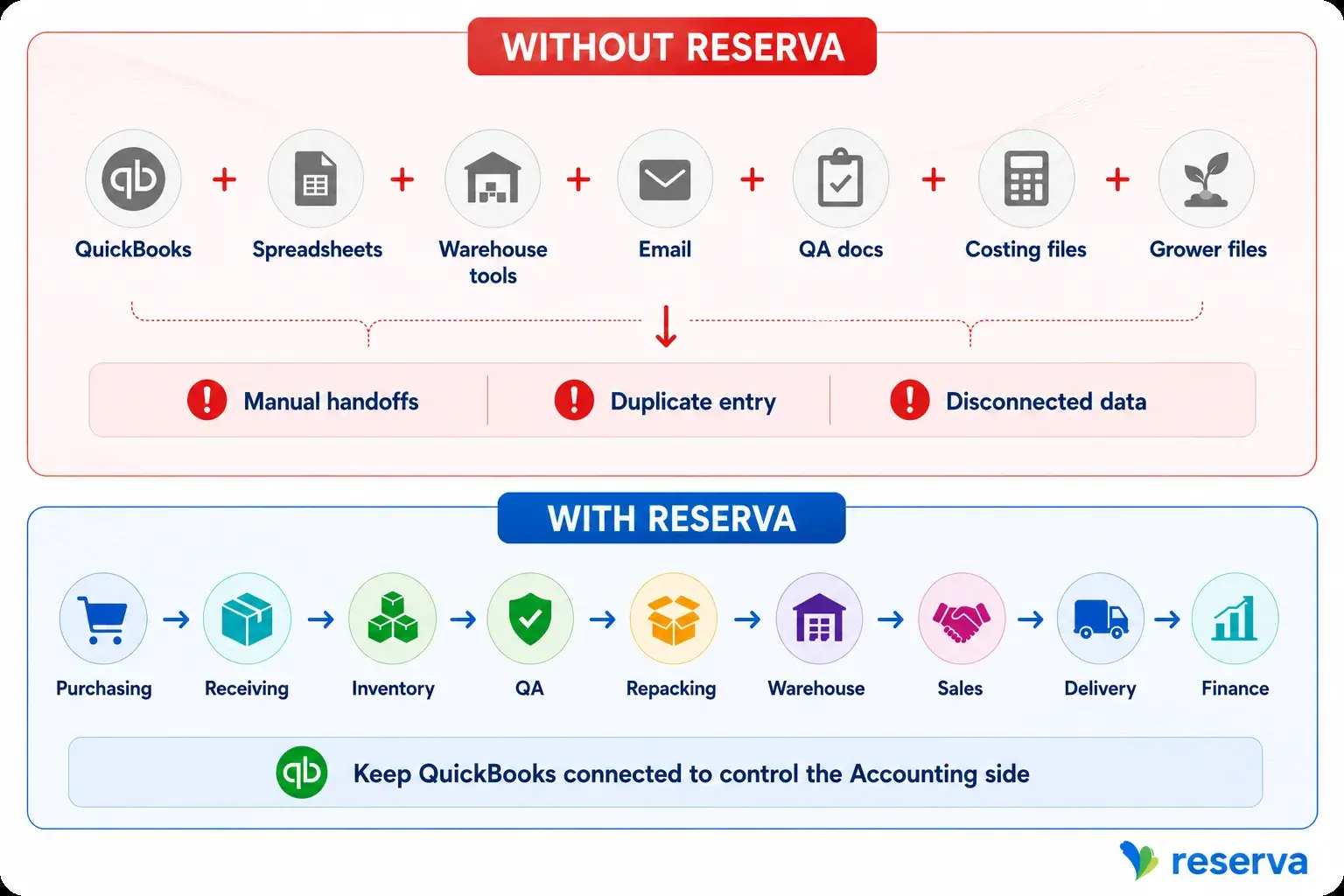
Fresh produce businesses don't need to replace QuickBooks simply because daily operations are becoming more complex. But when critical produce workflows increasingly happen across spreadsheets, separate tools and manual processes, it may be time to add an operational system around the initial accounting foundation.
Your team needs to know what you have by lot, pallet, location, condition and shelf life and keep it aligned with purchasing, sales and accounting.
Following product from receiving through QA, repacking, inventory, sales and delivery means searching different systems, files or people for answers.
Freight, cooling, customs, handling, repacking, claims and credits change the real cost of product. When those costs live elsewhere, margin becomes something you reconstruct later.
Repacking, grading, palletization, grower settlements, consignment, passings, BOLs, labels and load coordination are daily workflows, not exceptions.
Orders, receipts, inventory changes and costs are copied between systems, adding work, increasing errors and creating constant reconciliation.
When teams have to call, message or email each other to confirm inventory, order status, receiving, QA or delivery activity, critical information lives with people instead of in the system.
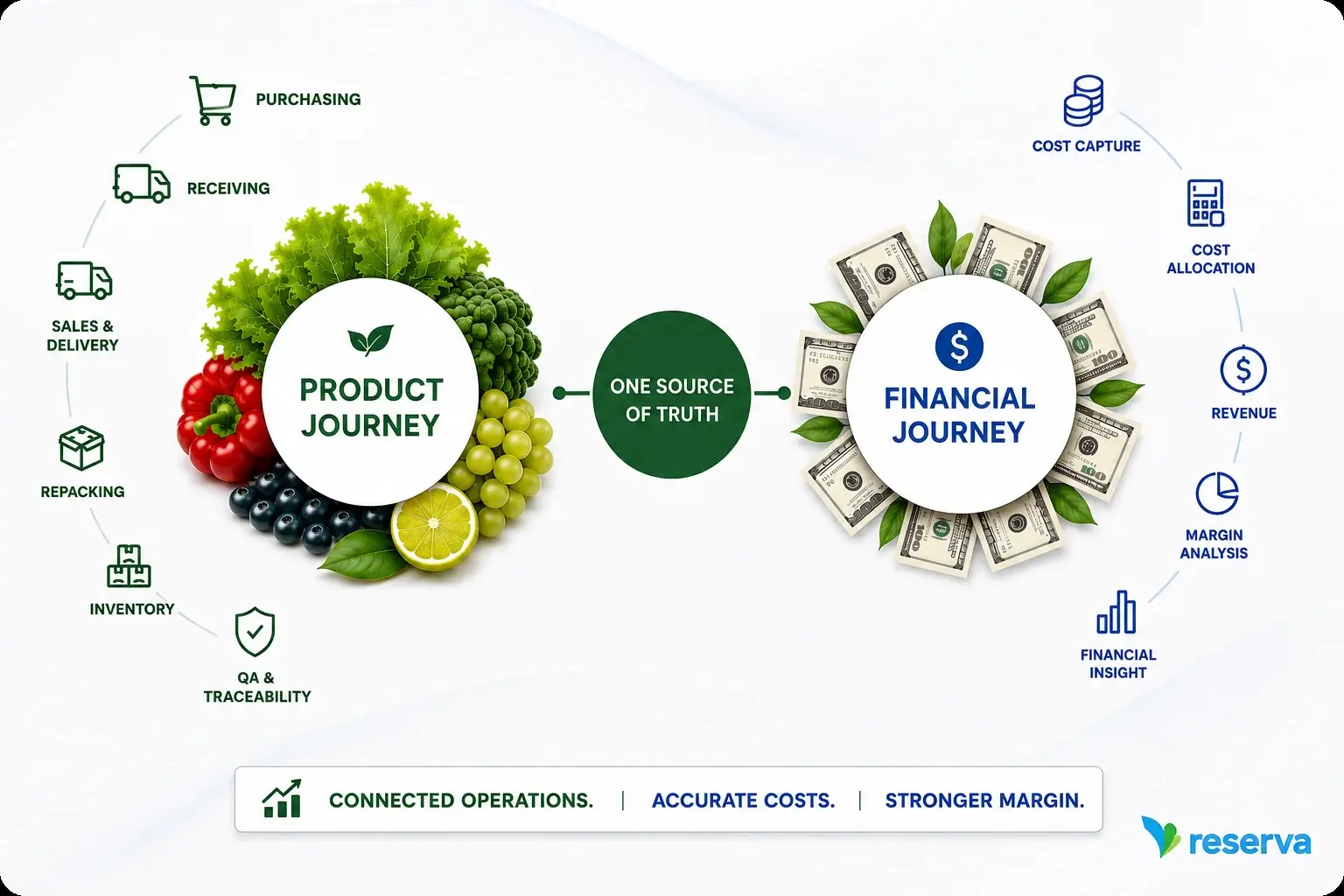
Running a produce business isn't a series of isolated transactions. Every purchase, receipt, quality decision, inventory movement, repack and delivery can ultimately affect availability, cost, revenue and margin.
Reserva connects that entire product journey with its financial impact. Information flows across the business as transactions happen, giving operations and finance a shared view of what is happening, what it costs and how it affects margin, without piecing the story together from separate systems.
There’s more than one way to build the technology stack behind a produce business. As operations grow, the systems behind them have to support more than transactions: they need to help produce teams manage product, maintain control, respond quickly and understand what is happening across the business.
See how a QuickBooks-centered setup and Reserva ERP compare across the capabilities that matter in day-to-day produce operations.
| OPERATIONAL AREA | QUICKBOOKS APPROACH | RESERVA ERP APPROACH | WHY IT MATTERS IN PRODUCE |
|---|---|---|---|
| Accounting & Finance | Excellent core accounting with a mature ecosystem. | Accounting and cash-flow context connected to produce transactions and operations. | Finance can reflect what was received, repacked, delivered and invoiced. |
| Reporting | Strong financial reporting, dashboards and third-party reporting options. | Financial and produce-operational reporting share the same transaction context. | Teams can investigate margin, stock and fulfillment without rebuilding the story manually. |
| Inventory | QuickBooks Online inventory depends on plan. Enterprise offers stronger inventory features in eligible editions. | Produce-native inventory by lot, pallet, location, grade, pack, QC status and availability. | Quantity alone does not explain whether product can satisfy a customer commitment. |
| Lots, Expiry & Recalls | Enterprise Advanced Inventory supports lot or serial tracking, expiration dates and recall-oriented reports. | Lot traceability is connected to receiving, movements, repacks, QA, shipments and customer impact. | A recall requires more than finding a lot number; teams must understand its full journey quickly. |
| Warehouse Execution | Enterprise editions can support multi-location inventory, bins, barcode scanning and pick-pack-ship. | Receiving, palletization, assignment, picking, substitutions, loading and delivery are produce-aware workflows. | Warehouse decisions depend on quality, freshness, pack, customer rules and delivery timing. |
| Landed Cost & Margin | Enterprise Platinum and Diamond include landed-cost capabilities; broader produce costs may still span systems. | Operational events, shrink, repacks, freight and product costs remain connected to lot and margin visibility. | Produce margin changes after receiving, not only when an invoice is entered. |
| System Landscape | A broad integration ecosystem can extend QuickBooks as requirements grow. | One produce-focused platform reduces operational handoffs and reconciliations. | Every integration adds ownership, maintenance and another place for data to disagree. |
| Repacking & Transformations | Assemblies and third-party tools may cover some transformations, depending on the setup. | Repacking and scrapping are core workflows that preserve inventory, cost and traceability context. | Changing pack, grade or product identity affects availability, margin and traceability. |
| Quality Control | Typically handled through fields, attachments, add-ons or a separate quality process. | QA checks and holds are tied to receiving, lots, pallets, inventory and shipments. | Quality outcomes directly affect what can be sold, substituted or rejected. |
| Grower Workflows | Usually managed through spreadsheets, customization or connected applications. | Grower and producer workflows are part of the produce operating model. | Source, program, product, cost and settlement context need to remain connected. |
Accuracy Note: QuickBooks is a product family where different capabilities vary by product and edition. QuickBooks Enterprise, in particular, offers more advanced inventory functionality.
Best when accounting is the main system need, operations are simple and surrounding tools are not creating meaningful cost, delay or risk.
Best when the team wants better control of orders, inventory, traceability and warehouse workflows without changing its familiar accounting environment immediately.
Best when the business is ready to reduce system fragmentation and connect accounting directly with sales, purchasing, inventory, costing and produce operations.
Yes, depending on the QuickBooks product and plan. QuickBooks Enterprise offers more advanced inventory functionality, including lot and serial tracking, barcode scanning and pick-pack-ship capabilities. Reserva’s distinction is not that QuickBooks lacks inventory. It is that inventory sits at the center of produce-specific workflows such as receiving, QA, traceability, repacking, warehousing, costing and grower programs.
No. You can keep QuickBooks for accounting while Reserva manages your produce operations. This gives businesses a lower-disruption way to add operational capabilities without immediately changing the accounting environment their finance team already knows.
Yes. Reserva can also support an integrated model where accounting and produce operations run together. This gives you the flexibility to keep QuickBooks initially and move more of the business into Reserva when and if that makes sense.
You can, and for many businesses that approach works well for a long time. The challenge comes when duplicate entry, integrations, manual checks and reconciliation begin consuming significant time, or when different systems provide different answers about inventory, traceability, cost or margin.
No. The need for an ERP is often driven more by operational complexity than employee count. A smaller business managing multiple lots, repacking, grower programs, complex costing, warehouse activity or strict traceability may need stronger operational controls earlier than a much larger but simpler operation.
They cover different scopes, so subscription price alone does not provide a complete comparison. Consider the broader technology stack around QuickBooks, including operational software, integrations and other tools, as well as the time spent on duplicate entry, reconciliation and manual processes. Reserva brings a much broader set of produce operations into one ERP.
Reserva connects traceability to the product as it moves through the operation, including receiving, lots and pallets, inventory movements, QA, repacking, sales and delivery. This helps maintain the history of the product even when it is moved or transformed.
Reserva is designed to track produce through conversions, repacking, grading and palletization. The relationship between incoming and resulting product can remain traceable, while associated costs can be allocated back to the relevant product and lots.
Yes. Reserva can connect operational activity with costs such as freight, customs, inspections, cooling, handling, sorting, grading, repacking and outbound expenses. Because those costs can follow the underlying transactions and product, teams can build a more complete view of cost and profitability instead of reconstructing it later from separate files.
It depends on the scope of the project, including data migration, workflows, integrations and any required customization. Importantly, adoption does not have to be an all-or-nothing event. A business can keep QuickBooks for accounting and introduce Reserva around the operational areas creating the most friction, then expand from there as needed.
See how Reserva can bring orders, inventory, traceability, warehouse workflows, produce costing and finance into one clearer operation
See Reserva ERP in Action